


There is an unspoken rule for anyone visiting Bahia: If you pass through Salvador, you have to pass by Valmir. In the world of Capoeira, Valmir das Biribas isn’t just an artisan; he is the heartbeat of the instrument itself. When you think of an authentic cabaça or the perfect curve of a verga, his atelier window in downtown Salvador is the first image that comes to mind.

A Legacy Glued to History
Valmir’s workshop is located at a literal crossroads of history, right next to the Elevador Lacerda and facing the Mercado Modelo. This is the exact scenery where old capoeiristas once worked the docks and, in their precious breaks, vadiavam (played capoeira).
The history of this shop is a timeline of devotion:
-
18 years: The time Valmir’s father spent at the bench.
-
40 years: Valmir’s own tenure as a master luthier.
-
58 years: Total legacy of craft right in front of the Port of Salvador.
Entering his workshop feels like stepping into the "heart of Salvador." It’s a place where local legends drop by for a coffee and amazed travelers buy a piece of Bahia to take the sound of the berimbau to the far corners of the world.

The Pioneer of Berimbau Export
Long before "Global Trade" was a buzzword for the arts, Valmir was navigating the complex waters of international shipping. As someone with a degree in Foreign Trade, I can tell you: Valmir’s insights on MAPA (wood material regulations) and global shipping lines were revolutionary.
He learned the hard way—confronting bureaucracies that didn't understand that a Berimbau from Bahia is a sacred object, not just "timber." He once told me about being summoned by the Federal Revenue to explain his exports. His response to the inspector remains legendary:
"A capoeira artisan is attacking nature? And the oil companies cutting down the Amazon, aren't they?"
Modern Alchemy: From Urban Trash to Sacred Sound
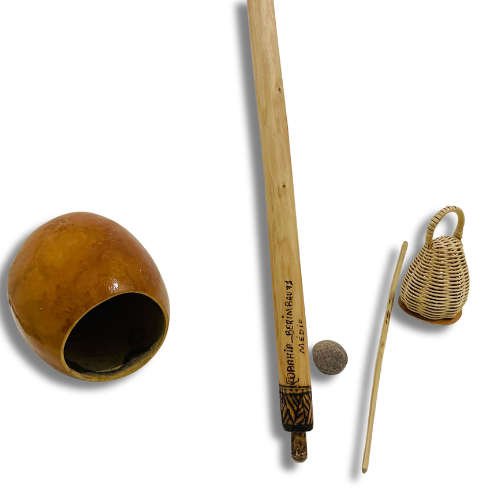
Valmir often says: “Anyone can make a berimbau, but not everyone can make an instrument.” The difference lies in the details and the soul. Valmir is a master of the entire lifecycle of the instrument:
-
Sustainability: He doesn’t just harvest Biriba wood; he manages the replanting, respecting the natural cycle of the forest.
-
The Cabaça: The gourds are grown and harvested from his own farm.
-
Upcycling: The arame (wire) he uses is salvaged from discarded tires in Salvador’s tire shops.
He practices a form of modern alchemy—taking what others see as "urban trash" or "just a stick" and transforming it into a Berimbau Angola that carries the weight of centuries.
"It is an Art"
For Valmir, the process is spiritual. As of January 2026, he continues to refine his "Berimbau Angola Pastinha" style, keeping the roots of the art alive.
"I consider it an art, yes. Because from the moment you take a piece of wood... and you transform that into sound, it is an art."
If you are looking for an authentic instrument with history, sustainability, and the true soul of Bahia, Valmir is the master you seek.
Watch the "Wizard of Woods" in Action
Note: To see the Master's process, remember to turn on automatic English captions.




0 comments